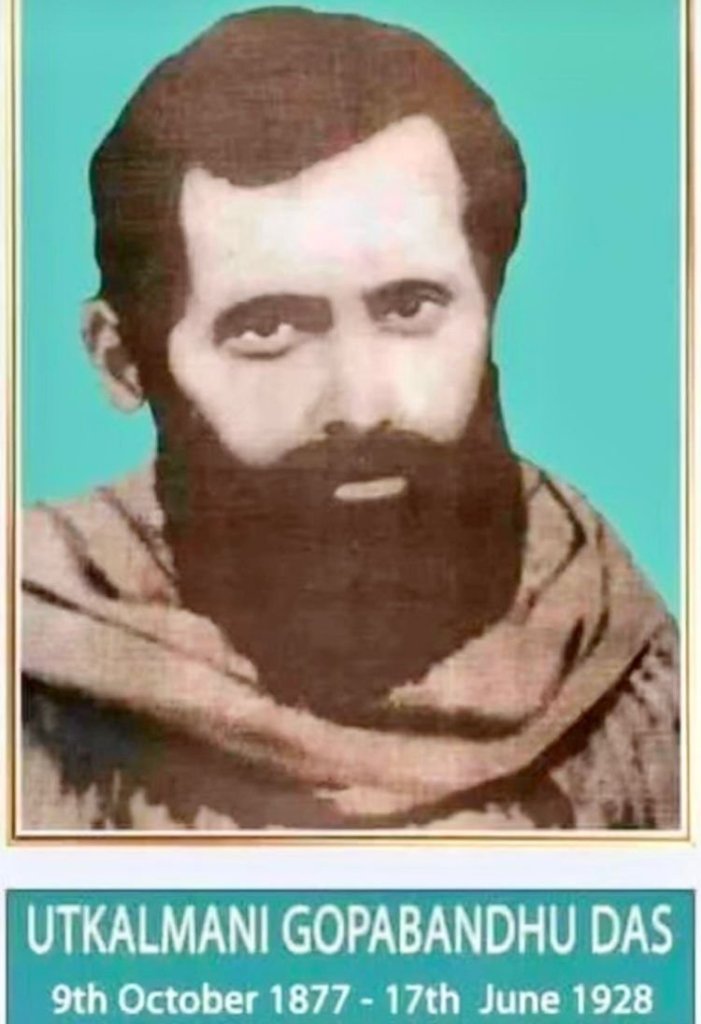
Gopabandhu Das (1877–1928), popularly known as Utkalamani Gopabandhu Das (Jewel of Utkal or Odisha), was a social worker, reformer, political activist, journalist, poet and essayist.

Gopabandhu Das was born on 9 October 1877 in Suando village, near Puri, Odisha in a Brahmin family. His mother was Swarnamayee Devi, the third wife of Daitari Dash. His father was a mukhtiar and the family were reasonably well-off. Das married Apti at the age of twelve but continued his education. He had basic schooling in the village before progressing to a middle school nearby. Then, in 1893, by which time his mother had died, Das joined Puri Zilla School. There he was influenced by Mukhtiar Ramchandra Das, a teacher who was both a nationalist and a proponent of public service in aid of people in distress. Becoming organising his fellow children in the spirit of co-operation, the inadequate response of authorities for the victims of an outbreak of cholera prompted him to start a voluntary corps called Puri Sava Samiti. Its members helped those suffering from the outbreak and also cremated the dead.
Das, whose father by now had died, progressed to Ravenshaw College in Cuttack. He became a regular contributor to local literary magazines called Indradhanu and Bijuli, where he argued that any modern literary movement, just like any modern nation, could not be a clean break with the old but rather had to acknowledge and base itself on its past. In one instance, he submitted a satirical poem that so enraged the Inspector of Schools that Das was punished when he refused to apologise for it.
It was while at Ravenshaw that Das started a discussion group, called Kartavya Bodhini Samiti (Duty Awakening Society), in which he and his friends considered social, economic and political problems. It was also during this time, in 1903, that he attended a meeting of the Utkal Sammilani (Utkal Union Conference), where he disagreed with Madhusudan Das’s suggestion that Odia speaking areas should be amalgamated with the Bengal Presidency. These extra-curricular activities, which also included helping the victims of flooding, impacted on his academic studies such that he failed his degree examination, although he gained his BA at the second attempt. It was also while at Ravenshaw that his new-born son died; he explained his preference to deal with flood victims on that occasion rather than be with his sick son as being because “There are so many to look after my son. What more can I do? But there are so many people crying for help in the affected areas and it is my duty to go there. Lord Jagannath is here to take care of the boy”.
Das progressed to Calcutta University, where he obtained an MA and LL.B while simultaneously devoting much of his energies in attempts to improve the education of Oriya people who were living in the city, for whom he opened night schools. His desire to bring about social reform and educational improvements was influenced at this time by the philosophy of the Swadeshi movement. His wife died on the day he heard that he had passed his law examinations. Now aged 28, all of his three sons had died and he chose to give up care of his two daughters to an older brother, along with his share of property in Suando.
Das arrived at his first job as a teacher in Nilagiri in Balasore district of ODISHA. He then became a lawyer, variously described as being based in Puri and in Cuttack. In 1909, Madhusudan Das appointed him to be State Pleader for the princely state of Mayurbhanj.
In 1913 or 1915, Das launched and acted as editor for a short-lived monthly literary magazine titled Satyabadi from the campus of his school. Through this he was able to indulge his childhood aspirations to be a poet, while contributions also came from other members of the school’s staff, including Nilakantha Das and Godabarish Mishra.
A few of his literary works are as follows:
– Karakabita
– Bandira Atmakatha
(Translated as The prisoner’s auto biography in 1946)
– Dhramapada (in Odia)
– Abakasa-chinta (in Odia) by Satyabadi Press
Gopabandhu became All India Vice-president of the Lok Sevak Mandal in April 1928. He became ill while attending a society meeting in Lahore and died on 17 June 1928.
Brahmananda Satapathy, a professor of political science, has said of Das that “His crusade against untouchability, advocacy of widow remarriage, campaign for literacy, new model of education, stress on both rights and duties, emphasis on women education, particularly vocational training and above all a deep commitment and compassion for poor and destitutes have immortalised him in Orissa and India”.
Source: Wiki
 B +Ve!!