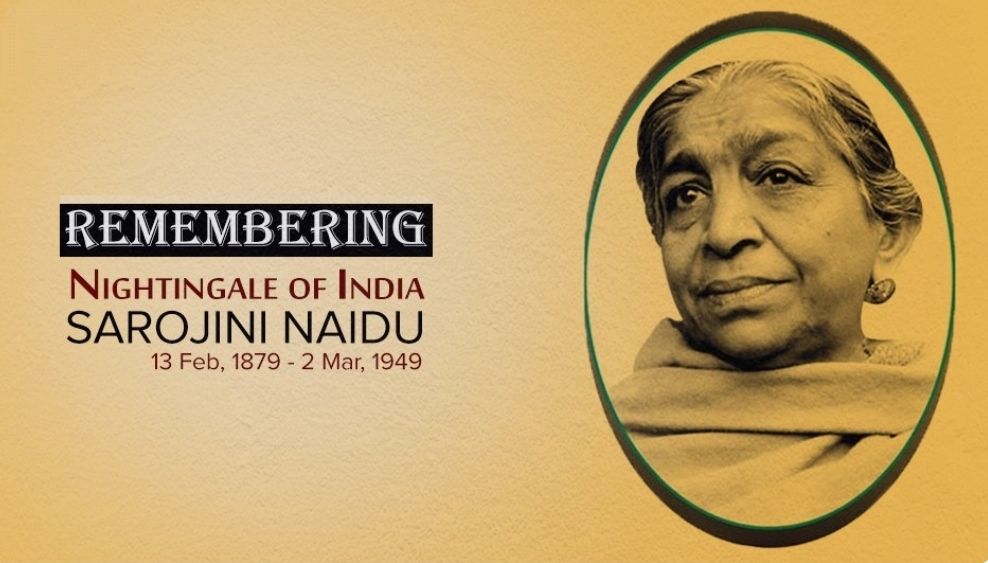
Emergence: 13 February 1879
Demise: 2 March 1949
Sarojini Naidu was an Indian political activist and poet who served as the first Governor of United Provinces, after India’s independence. She played an important role in the Indian independence movement against the British Raj. She was the first indian woman to be president of the Indian National Congress and appointed as governor of a state.
Born in a Bengali family in Hyderabad, Naidu was educated in Madras, London and Cambridge. Following her time in Britain, where she worked as a suffragist, she was drawn to the Congress party’s struggle for India’s independence. She became a part of the national movement and became a follower of Mahatma Gandhi and his idea of swaraj (self rule). She was appointed Congress president in 1925 and, when India achieved its independence, became Governor of the United Provinces in 1947.
Naidu’s literary work as a poet earned her the nickname the “Nightingale of India” by Gandhi because of the colour, imagery and lyrical quality of her poetry. Her œuvre includes both children’s poems and others written on more serious themes including patriotism and tragedy. Published in 1912, “In the Bazaars of Hyderabad” remains one of her most popular poems.
Sarojini Naidu passed her matriculation examination to qualify for university study, earning the highest rank, in 1891, when she was twelve. From 1895 to 1898 she studied in England, at King’s College, London and then Girton College, Cambridge, with a scholarship from the Nizam of Hyderabad. In England, she met artists from the Aesthetic and Decadent movements.
Naidu began writing at the age of 12. Her play, Maher Muneer, written in Persian, impressed the Nizam of Kingdom of Hyderabad.
Naidu’s poetry was written in English and usually took the form of lyric poetry in the tradition of British Romanticism, which she was sometimes challenged to reconcile with her Indian nationalist politics. She was known for her vivid use of rich sensory images in her writing, and for her lush depictions of India. She was well-regarded as a poet, considered the “Indian Yeats”.
Her first book of poems was published in London in 1905, titled “The Golden Threshold”. The publication was suggested by Edmund Gosse, and bore an introduction by Arthur Symons. It also included a sketch of Naidu as a teenager, in a ruffled white dress, drawn by John Butler Yeats. Her second and most strongly nationalist book of poems, The Bird of Time, was published in 1912. It was published in both London and New York, and includes “In the Bazaars of Hyderabad”.[30] The last book of new poems published in her lifetime, The Broken Wing (1917). It includes the poem “The Gift of India”, critiquing the British empire’s exploitation of Indian mothers and soldiers, which she had previously recited to the Hyderabad Ladies’ War Relief Association in 1915. It also includes “Awake!”, dedicated to Muhammad Ali Jinnah, which she read as the conclusion to a 1915 speech to the Indian National Congress to urge unified Indian action. A collection of all her published poems was printed in New York in 1928. After her death, Naidu’s unpublished poems were collected in The Feather of the Dawn (1961), edited by her daughter Padmaja Naidu.
Naidu’s speeches were first collected and published in January 1918 as The Speeches and Writings of Sarojini Naidu, a popular publication which led to an expanded reprint in 1919 and again in 1925.
Naidu died of cardiac arrest at 3:30 PM (IST) on 2 March 1949 at the Government House in Lucknow. Upon her return from New Delhi on 15 February, she was advised to rest by her doctors, and all official engagements were canceled. Her health deteriorated substantially and bloodletting was performed on the night of 1 March after she complained of severe headache. She collapsed following a fit of cough. Naidu was said to have asked the nurse attending to her to sing to her at about 10:40 PM (IST) which put her to sleep. She subsequently died, and her last rites were performed at the Gomati River.
Naidu is known as “one of India’s feminist luminaries”. Naidu’s birthday, 13 February, is celebrated as Women’s Day to recognise powerful voices of women in India’s history.
Composer Helen Searles Westbrook (1889–1967) set Naidu’s text to music in her song “Invincible.”
As a poet, Naidu was known as the “Nightingale of India”. Edmund Gosse called her “the most accomplished living poet in India” in 1919.
Golden Threshold in 2015
Naidu is memorialized in the Golden Threshold, an off-campus annex of University of Hyderabad named for her first collection of poetry. Golden Threshold now houses the Sarojini Naidu School of Arts & Communication in the University of Hyderabad.
Asteroid “5647 Sarojini”, discovered by Eleanor Helin at Palomar Observatory in 1990, was named in her memory. The official naming citation was published by the Minor Planet Center on 27 August 2019 (M.P.C. 115893).
In 2014, Google India commemorated Naidu’s 135th birth anniversary with a Google Doodle.
The first biography of Naidu, Sarojini Naidu: a Biography by Padmini Sengupta, was published in 1966. A biography for children, Sarojini Naidu: The Nightingale and The Freedom Fighter, was published by Hachette in 2014.
In 1975, the Government of India Films Division produced a twenty-minute documentary about Naidu’s life, “Sarojini Naidu – The Nightingale of India”, directed by Bhagwan Das Garga.
In 2020, a biopic was announced, titled Sarojini, to be directed by Akash Nayak and Dhiraj Mishra, and starring Dipika Chikhlia as Naidu.
Reference: Wiki
 B +Ve!!